Last updated on July 14th, 2024 at 06:02 pm
South Asia The Contemporary World
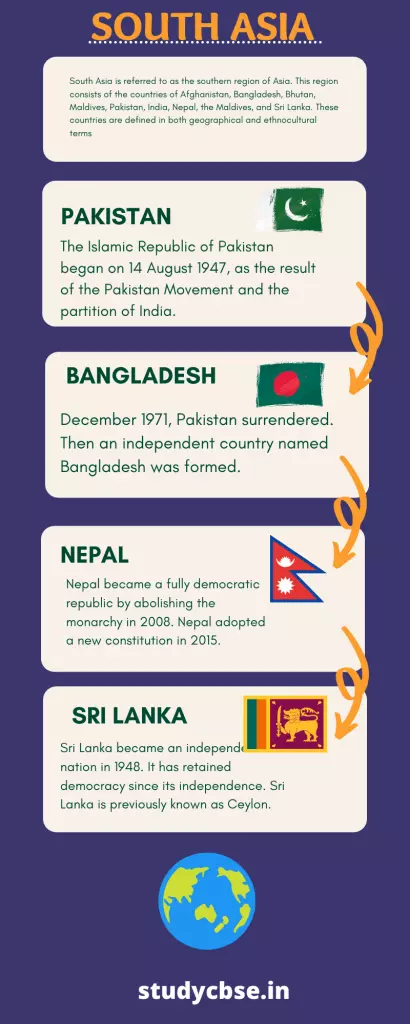
south asia is referred to as the southern region of Asia. This region consists of the countries of Afghanistan, Bangladesh, Bhutan, Maldives, Pakistan, India, Nepal, the Maldives, and Sri Lanka. These countries are defined in both geographical and ethno-cultural terms.
The people in these countries desire for democracy which can be drawn from the examples of Bangladesh, Nepal, Pakistan, Sri Lanka and Maldives.
Pakistan began Post Cold War period with successive democratic governments but suffered a military coup in 1999.
In Nepal successful uprising led to restoration of democracy in 2006.
India and Sri Lanka have also operated a democratic system, despite many limitations and even Maldives have strengthened democracy.
Pakistan: The Military And Democracy
The Islamic Republic of Pakistan began on 14 August 1947, as the result of the Pakistan Movement and the partition of India.
The country became an independent nation within the British Commonwealth Since its independence, Pakistan has had a vibrant yet turbulent political history, often characterized by martial law and inefficient leadership.
The Pakistani military establishment has played an influential and major role in mainstream politics throughout
In Pakistan, military rule and democracy are two sides of the coin, which can be seen as:
General Ayub Khan was elected as the second president (1958-1969), but thrown away by the military due to dissatisfaction with his rule. The first military rule in Pakistan took place under General Yahya Khan.
After 1971, a new government was formed under the leadership of Zulfikar Ali Bhutto, but lasted till 1977, he was removed by General Zia-Ul-Haq. But again he had to face the pro-democracy movement from 1982 onwards.
Again an elected democratic government was established in 1988 under Benazir Bhutto but had to face tough competition from the other parties
Later on, history repeated. Army stepped in again and General Pervez Musharraf took the command in 1999 and got elected in 2005
The first successful democratic transition took place in May 2013.
There were several factors that led to the failure of Pakistan in building a stable government. Social dominance of the army, religion and landowners are the main factors. Also war-like situations exist between India and Pakistan.
Bangladesh:Democracy
Bangladesh was an integral part of Pakistan from 1947 to 1971, which was known as East Pakistan. A popular struggle started against West Pakistan due to their dominance was led by Sheikh Mujibur Rahman.
This country was formed by migrants from West Pakistan. In the 1970 election, the Awani league under the leadership of Sheikh Mujibur Rahman won all seats but the government dominated by the West Pakistani leadership refused to convene the assembly.
The Pakistani army tried to suppress the movement which led to a large number of migrations to India.
India was in favour of the creation of East Pakistan. It intervened and supported the demand financially and militarily.
Consequently, in December 1971, Pakistan surrendered. Then an independent country named Bangladesh was formed.
Bangladesh had drafted its own constitution declaring faith in secularism, democracy and socialism. In 1975, Sheikh Mujibur Rehman formed a presidential setup.
Sheikh Mujibur was assassinated and a military rule was established under Ziaur Rahman.
He was also assassinated under the rule of Lt Gen H.M. Ershad. He continued military rule.
Later a strong pro-democratic movement was again started which led to election in 1991. Since then representative democracy which is based on multi-party elections has been working in Bangladesh.
Nepal: Monarchy And Democracy
Nepal was the only Hindu kingdom of the world with the constitutional monarchy and multi-party democracy.
Nepal is a federal multiparty republic with two legislative houses, National Assembly and House of Representatives.
The struggle for restoration of democracy began in 1990 and 2007 when king Gyanendra restored house of representatives.
The tenure of Nepal’s democratic governments was very short and full of problems.
During 1990s Maoists of Nepal had their influence in many parts. They wanted an armed rebellion against the king. This led to violent clashes between the Maoist guerrillas and the king’s army.
The Nepalese Civil War took place from 1996 to 2006. There was a triangular conflict between the king’s army, supporters of democracy and Maoists.
Parliament was abolished by the king Gyanendra in 2002 and sacked the government.
Again in 2006, after a nationwide democratic movement, King was forced to reinstate the House of Representatives.
This was led by a coalition of seven parties (Seven Party Alliance), Maoists and social workers.
Nepal became a fully democratic republic by abolishing the monarchy in 2008. Nepal adopted a new constitution in 2015.
Sri Lanka: Ethnic Conflict And Democracy
Sri Lanka became an independent nation in 1948. It has retained democracy since its independence. Sri Lanka is previously known as Ceylon. After independence Sri Lanka’s political regime was dominated by the Sinhalese community.
There was an ethnic conflict between Sinhalese and Tamils origin people. According to the Sinhalese, the Ceylon region belonged to Sinhala people only and not to the Tamils who migrated from India.
This led to the formation of Liberation Tiger of Tamil Eelam (LTTE), a militant organization, who demanded a separate state for Tamil.
Tamil people in India pressurised The Government of India for the protection of the Tamils in Sri Lanka.
India signed an accord with Sri Lanka and sent a Peace Keeping Forces to stabilize relations between the Sri Lankan Government and the Tamils.
In due course, the force got into a fight with the LTTE. Later on the Indian Peace Keeping Force (IPKF) was pulled out of Sri Lanka in 1989 without achieving its aims.
Presently, the LTTE has been destroyed by the Sri Lankan Army and the area under LTTE has been recovered.
In spite of the Ethnic conflict, the economy of Sri Lanka has always been considerably high. Sri Lanka has maintained a democratic political system.
Sri Lanka is one of the first developing countries to control population growth rate, liberalized economy, and bears highest per capita Gross Domestic Product.
India and its Neighbors
India’s neighboring countries are Bangladesh, Nepal, Sri Lanka, Bhutan, Maldives and Pakistan.
There are some issues of conflict between India and these countries.
India-Pakistan Conflicts
After independence, India-Pakistan conflicts in the South Asian region are most prominent.
The wars between these countries took place in 1947-48,1965 and 1971 on the issues of Pak Occupied Kashmir (POK), Line of Control (LOC) and Bangladesh independence.
Other than these both the countries face conflict over strategic issues like the control of the Siachen glacier and over acquisition of arms.
Other issues of conflict among the two countries are over the sharing of river waters of the Indus river system.
Both the governments are suspicious to each other over security issues. Suspicious on the ground of Pakistani strategy to help Kashmiri militants and ISI to be involved in the Anti-India campaign.
Pakistan blames India for making trouble in Sindh and Balochistan.
Both the countries have agreed to start a bus Service between Amritsar and Lahore and to religious places such as Nankana Sahib.
In September 2006, the two countries reached agreement on instituting a joint anti-terror mechanism and started the comprehensive dialogue.
India and Bangladesh
Both countries has experienced some differences over the issues of sharing of Ganga and Brahmaputra river water, illegal immigration to India, refusal to allow Indian troops, support for anti Indian-Islamic fundamentalists, and not to export natural gas to India.
India and Nepal
Both experiences differences on the issues of Nepal’s relations with China and inaction against anti-Indian elements i.e. Maoists.
Both the countries signed the treaty of trade and commerce in 2005 and friendship in 2006, to provide financial and technical assistance and to allow citizens to move each other’s country without visas and passports.
India and Bhutan
They do not have any major conflict, but attached on the issues to need out the guerrillas and militants from Northeastern India.
Involvement of India in big hydroelectric projects in Bhutan is the biggest source of development aid.
India and Maldives
India is supportive to Maldives economy, tourism and fisheries. In November 1988, India reacted quickly against an attack from Tamil Mercenaries in the Maldives.
There is also an outside power which influences the South Asian region. China and the United States remain key players in South Asian politics.
Peace And Cooperation In South Asia
In spite of the above-mentioned conflicts and differences, South Asian countries are known for cooperation and friendly relations among themselves.
SAARC
A major regional initiative has been taken in the form of South Asian Association for Regional Cooperation (SAARC) in 1985 to evolve cooperation among each other.
SAARC members signed South Asian Free Trade Agreements (SAFTA) in 2004 to form a free trade zone for the whole of South Asia across the border. SAFTA aims at lowering trade tariffs by 20 percent by 2007.
Objectives of SAARC
1. Promote the welfare of the people of South Asia and improve their quality of life.
2. Accelerate economic growth, social progress and cultural development in the region by providing all individuals the opportunity to live in dignity and realise their full potential.
3. Promote and strengthen collective self-reliance among the countries of South Asia.
4. Contribute to mutual trust, understanding and appreciation of one another’s problems.
5. Promote active collaboration and mutual assistance in the economic, social, cultural, technical and scientific fields.
6. Strengthen cooperation with other developing countries.
7. Strengthen cooperation among themselves in international forums on matters of common interest.
8. Cooperate with international and regional organisations with similar aims and purposes.
Suggestions To Make SAARC Effective
1. The work on creating a South Asian free trade agreement should begin in earnest soon.
2. The FICCI (Federation of Indian Chambers of Commerce and Industry) called for the liberalisation of visas for doctors, lawyers, engineers, teachers etc
3. Long term multipurpose visas should be granted to traders and tourists.
Important Facts To Remember
1. Bilateral Talks: Talks involving the two countries without any other mediation.
2. Geo-Politics: Geo-politics refers to the Association of countries who are bound with each other geographically and their interests are also interlinked with each other politically and economically.
3. Indian Peace Keeping Force (IPKF ): It was sent by India in Sri Lanka to support the demand of Tamils to be recognised.
4. SAARC: It stands for South Asian Association for Regional Cooperation having seven members and aims at mutual trust and understanding.
5. SAFTA: It is South Asia Free Trade Area. Agreement to trade free from custom restrictions and duties by its member states.
6. LTTE: The Liberation Tigers of Tamil Elam in Sri Lanka which demanded a separate state for Tamils.
Important Dates
1. 1947: India and Pakistan emerge as an independent nation after the end of British rule.
2. 1948: Sri Lanka gained independence. Indo-Pak conflict over Kashmir.
3. 1954-55: Pakistan joins the Cold War military blocs, SEATO and CENTO.
4. September 1960: India and Pakistan sign the Indus Waters Treaty.
5. 1962: Border conflicts between India and China.
6. 1965: Indo-Pak War, UN India-Pakistan Observation Mission.
7. 1966: India and Pakistan sign the Tashkent Agreement: Six- Point proposal of Sheikh Mujib- ur-Rahman for greater autonomy to East Pakistan.
8. March 1971: Proclamation of independence by leaders of Bangladesh.
9. August 1971: Indo-Soviet Treaty of friendship signed for 20 years.
December 1971: Indo-Pak war, Liberation of Bangladesh.
10. July 1972: India and Pakistan sign the Shimla Agreement.
11. May 1974: India conducts nuclear test.
12. 1976: Pakistan and Bangladesh establish diplomatic relations.
13. December 1985: South Asian leaders sign the SAARC Charter at the first summit in Dhaka.
14. 1987: Indo-Sri Lanka Accord: Indian Peace Keeping Force (IPKF) operation in Sri Lanka (1987-90).
15. 1988: India sends troops to the Maldives to foil a coup attempt by mercenaries.India and Pakistan sign the agreement not to attack nuclear installations and facilities of each other.
16. 1988-91: Democracy restoration in Pakistan, Bangladesh and Nepal.
17. December 1996: India and Bangladesh sign the Farakka Treaty for sharing of the Ganga waters.
18. May 1998: India and Pakistan conduct nuclear tests.
19. December: India and Sri Lanka sign the Free Trade Agreement (FTA)
20. February 1999: Indian PM Vajpayee undertakes bus journey to Lahore to sign a Peace Declaration.
21. June-July 1999: Kargil conflict between India and Pakistan.
22. July 2001: Vajpayee-Musharraf Agra Summit unsuccessful.
24. January 2004: SAFTA signed at the 12th SAARC Summit in Islamabad.
Other Chapter Notes
- Class 12 Political Science Syllabus
- Chapter 1: Cold War Era and Non aligned Movement
- Chapter 2: The End of Bipolarity
- Chapter 3: New Centre Of Power
- Chapter 4: present
- Chapter 5: United Nation And Its Organisations
- Chapter 6: Globalization
- Chapter 7: Challenge Of Nation Building
- Chapter 8: Planned Development
- Chapter 9: India’s Foreign Policy
- Chapter 10: Parties And The Party Systems In India
- Chapter 11: Democratic Resurgence
- Chapter 12: Indian Politics: Trends And Developments
MCQ & Syllabus Notes
Frequently Asked Questions
What is geo-politics?
Geo-politics refers to the Association of countries who are
bound with each other geographically and their interests are also interlinked with each other politically and economically.
What is India Bangladesh conflict?
India and Bangladesh has experienced somedifferences over the issues of sharing of
Ganga and Brahmaputra river water, illegal
immigration to India, refusal to allow Indian troops, support for anti Indian-Islamic fundamentalists, and not to export
natural gas to India.
South Asia and The Contemporary World Unit 4 CBSE, class 12 Political science notes. This cbse Political Science class 12 notes has a brief explanation of every topic that NCERT syllabus has. You will also get ncert solutions, cbse class 12 Political Science sample paper, cbse Political Science class 12 previous year paper.
Final words
From the above article you must have learnt about ncert cbse class 12 Political Science notes of unit 4 South Asia and The Contemporary World. We hope that this crisp and latest Political Science class 12 notes will definitely help you in your exam.