Last updated on July 14th, 2024 at 05:19 pm
Cold War Era MCQ
Below are some of the very important NCERT Class 12 Cold War Era MCQ Chapter 1 with Answers. These Class 12 Cold War Era MCQ Chapter 1 have been prepared by expert teachers and subject experts based on the latest syllabus and pattern of term 1 and term 2. Questions with Answers to help students understand the concept.
MCQ Questions for Class 12 Cold War Era MCQ Chapter 1 are very important for the latest CBSE term 1 and term 2 pattern. These class 12 MCQ are very important for students who want to score high in CBSE Board.
We have put together these NCERT Questions of Class 12 Cold War Era MCQ Chapter 1 with answers for practice on a regular basis to score high in exams. Refer to these MCQs Questions with Answers here along with a detailed explanation.
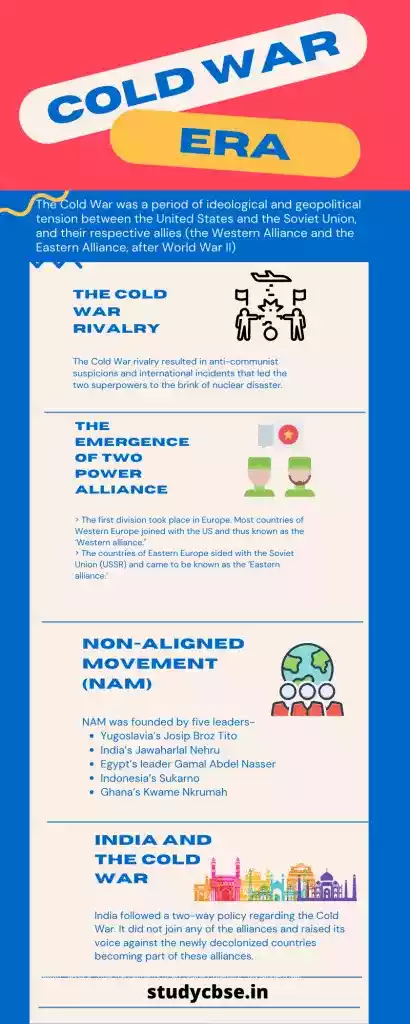
MCQ
1. The high point of Cold War was
(a) Cuban Missile Crisis
(b) Atomic bomb attack on Hiroshima and Nagasaki
(c) Establishment of SEATO and CENTO
(d) Establishment of NATO
Ans. (A)
Explanation: The Cuban Missile Crisis was a dangerous confrontation between the US and the USSR in which both of them came closest to nuclear conflict.
2. The Cold War is referred to the competition, the tensions and a series of confrontations between the:
(a) United States and the Soviet Union
(b) France and Germany
(c) India and Pakistan
(d) America and Africa
Ans. (A)
Explanation: In 1945, Allied Forces defeated the Axis Powers that marked the end of the Second World War, Both the super powers indulged in Cold War so that they could prove their superiority over the other.
3. Select the correct option for the Alliance and the organization it was formalized into
(a) The Eastern Alliance was formalized into UNO
(b) The Western Alliance was formalized into NATO
(c) The Central Alliance Was formalized into SEATO
(d) The Neutral Alliance was formalized into Peace keeping forces
Ans. (B)
Explanation: The Western alliance was formalized into the North Atlantic Treaty Organisation (NATO), which came into existence In April 1949 to provide security against the USSR. It was an association of twelve states which declared that armed attack on any one of them would be regarded as an attack on all of them.
4. Which set of the countries belonged to the NATO Group?
(a) Poland, Britain, Romania
(b) USA, Czech Republic, France
(c) United Kingdom, France, West Germany
(d) Spain, France, East Germany.
Ans: (C)
Explanation; ‘Evolve countries took part in the founding of NATO: Belgium, Canada, Denmark, France, Iceland, Italy, Luxembourg, the Netherlands, Norway, Portugal, the United Kingdom, and the United States, In 1952, Greece and Turkey became members of theAlliance, joined later by West Germany (in 1955) and Spain (in 1982),
5. Which of the following statements is true for the Cold war?
(a) The two superpowers were poised for direct confrontations in India (1950- 53), Gulf (1958-62)
(b) The two superpowers were poised for direct confrontations in Berlin only (1958-62)
(c) The two superpowers were poised for direct confrontations in Korea (1950 – 53), Berlin (1958-62)
(d) The two superpowers were poised for direct confrontations in Korea only (1950-53)
Ans. (C)
Explanation: The Cold War also led to several shooting Wars, but it is important to note that these crisis and wars did not lead to another World War. The two superpowers were poised for direct confrontations in Korea (1950 – 53), Berlin (1958 – 62), the Congo (the early 1960s), and in several other places.
6. Warsaw Pact was created in the
(a) 1935
(b) 1945
(c) 1955
(d) 1965
Ans. (C)
Explanation: The Warsaw Pact was established as a balance of power or counterweight to NATO.
7. Which one of the following statements is not correct about the ‘Non-Aligned Movement’?
(a) It suggested to the newly independent countries ways to stay out of alliances
(b) India’s policy of non-alignment was neither negative nor passive
(c) The non-aligned posture of India served its interests
(d) India was praised for signing the treaty of friendship with the USSR to strengthen NAM
Ans. (D)
Explanation: The name Non-Alignment was coined by Jawahar Lal Nehru in his 1954 speech in Colombo, Sri Lanka, after independence, India did not want to be part of these blocs led by the USSR or the USA, It chose to follow a nep-compliancepoli
8. Which of the following statements about the NIEO is false?
(a) Give the LDCs control over their natural resources.
(b) Obtain access to western markets.
(c) Reduce the cost of technology from western countries.
(d) Provide the developed countries with a greater role in international economic institutions.
Ans. (D)
Explanation: The crucial aim of the NIEO is to promote economic development among the poor countries through self- help and SouthSouth cooperation. The NIEO intends to deal with the major problems Of the South, such as balance of payments disequilibrium, debt crisis, exchange scarcity etc.
9. When did the Cuban Missile Crisis occur?
(a) 1967
(b) 1962
(c) 1960
(d) 1970
Ans: (B)
Explanation: In 1962 the Soviet Union began to secretly install missiles in Cuba to launch attacks on U.S. cities. The confrontation that followed, known as the Cuban missile crisis, brought the two superpowers to the brink of war before an agreement was reached to withdraw the missiles.
10. When did the Americans become aware of the weapons placed in Cuba by the USSR?
(a) On the first day
(b) One week later
(c) Three weeks later
(d) None of the above
Ans. (C)
Explanation: When USSR placed the missiles in Cuba, which was very dosed to the American mainland. Three weeks later an American U-2 spy plane secretly photographed nuclear missile sites being built by the Soviet Union on the island of Cuba.
11. What were the leaders of USSR worried about in 1961?
(a) That USA will attack China
(b) That USA will be the most powerful nation
(c) That USA will develop more nuclear weapons
(d) That USA will attack Cuba and overthrow Fidel Castro
Ans. (D)
Explanation: In April 1961, the leaders of ‘the Union of Soviet Socialist Republics (USSR) were worried that the United States of America (USA) would invade communist-ruled Cuba and overthrow Fidel.Castro.
12. Who was the President of USA during the Cuban Missile Crisis?
(a) Abraham Lincoln
(b) John F Kennedy
(c) Bill Clinton
(d) None of the above
Ans. (B)
13. When did the Cold War begin?
(a) After the Second World War
(b) During the Second World War
(c) Between 1914 and 1918
(d) Between 1939 and 1945
Ans. (A)
Explanation: The Cold War began after the surrender of Nazi Germany in 1945, when the unea«y alliance between the United States and Great Britain on the one hand and the Soviet Union on the other started to fall apart.
14. Which of the following statements about the Cold War is wrong?
(a) It was an ideological war between the superpowers.
(b) It was a competition between the US and Soviet Union and their respective allies.
(c) It triggered an arms race.
(d) The US and USSR were engaged in direct war.
Ans. (D)
Explanation: Neither the Soviet Union nor the United States officially declared war on each other, both of them were trying to prove themselves as a superpower.
15. Why did the US and USSR never fight a direct war against each other?
(a) because their economy was exhausted in WW2
(b) because both did not have any nuclear weapons
(c) because they understood the destruction caused by the use of atomic bombs
(d) All of the above
Ans. (C)
Explanation: While the Cold War was an outcome of the emergence of the US and the USSR as two superpowers rivaling each other, it was also rooted in the understanding that the destruction caused by the use of atom bombs would be too Costly for any country to bear.
16. Which among the following is not among the objectives of NAM?
(a) Enabling newly decolonized countries to pursue independent policies
(b) Not to joining any military alliances
(c) Following a policy of neutrality on global issues
(d) Focus on elimination of global economic inequalities
Ans. (C)
Explanation: NAM has sought to “create an independent path in world politics that would not result in member states becoming pawns in the struggles between the major powers.” It identifies the right of independent judgment.
17. Which of the following countries was not a member of NATO?
(a) France
(b) The U.S.A.
(c) England
(d) None of these
Ans. (D)
18. Write the names of the main countries of Axis Powers.
(a) Germany, Italy, and Japan
(b) India, Japan, Sri Lanka
(c) Bangladesh, Pakistan, China, India
(d) All of the above
Ans. (A)
19. In which year CENTO was established?
(a) 1956
(b)1957
(c) 1958
(d) 1955
Ans. (D)
20. In which year NAM was established?
(a) 1956
(b) 1960
(c) 1990
(d) 1957
Ans. (A)
21. The first non-aligned summit was held in the year 1961 in
(a) Venice
(b) Delhi
(c) Belgrade
(d) Dhaka
Ans. (C)
Political Science All Chapter Notes
- Class 12 Political Science Syllabus
- Chapter 1: Cold War Era
- Chapter 2: The End of Bipolarity
- Chapter 3: New Centre Of Power
- Chapter 4: South Asia and The Contemporary World
- Chapter 5: United Nation And Its Organisations
- Chapter 6: Globalization
- Chapter 7: Challenge Of Nation Building
- Chapter 8: Planned Development
- Chapter 9: India’s Foreign Policy
- Chapter 10: Parties And The Party Systems In India
- Chapter 11: Democratic Resurgence
- Chapter 12: Indian Politics: Trends And Developments
Assertion and Reasoning MCQs
Directions: In the following questions, a statement of Assertion (A) is followed by a statement of Reason (R). Mark the correct choice as:
(A) Both (A) and (R) are true, but (R) is the correct explanation of (A).
(B) Both (A) and (R) are true, but (R) is not the correct explanation of (A).
(C) (A) is true, but (R) is false.
(D) (A) is false, but (R) is true.
Q. 1. Assertion: Soviet Union, decided to convert Cuba into a Russian base.
Reason: Cuba was an ally of the Soviet Union and received both diplomatic and financial aid from it. Ans. Option (B) is correct.
Ans: 2
Explanation: Nikita Khrushchev decided to
convert Cuba into a Russian base as the ally, Cuba, was Very close to American cides or the mainland.
Q. 2. Assertion: The installation of these weapons put the US, for the first time, under fire from close range and nearly doubled the number of bases or cities in the American mainland which could be threatened by the USSR.
Reason: Nikita Khrushchev, the leader of the Soviet Union, decided to convert Cuba into a Russian base.
Ans. 1
Q. 3. Assertion: The US President, John F. Kennedy, and his advisers were reluctant to do anything that might lead to full-scale nuclear war between the two countries.
Reason: The possible clash (Cold War) between the two countries was avoided.
Ans. 3
Explanation: There were no direct military campaigns between the two main antagonists, the United States and the Soviet Union. Yet billions of dollars and millions of lives were lost in the fight.
Q. 4. Assertion: The Cold War was not simply a matter of power rivalries, of military alliances, and of the balance of power.
Reason: These were accompanied by a real ideological conflict as well, a difference over the best and the most appropriate way of organizing political, economic, and social life all over the world.
Ans. 1
Q. 5. Assertion: Smaller states got the promise of protection, weapons, and economic aid against their local rivals, mostly regional neighbours with whom they had rivalries.
Reason: The smaller states in the alliances used the link to the superpowers for their own purposes.
Ans. 1
Explanation: Smaller states depended a flot on superpowers for their development and protection. At times, it become mandatory for, them to join any of the blocs,
Q. 6. Assertion: The Western Alliance was formalized into an organization, the North Atlantic Treaty Organization (NATO), which came into existence in April 1949.
Reason: The Eastern Alliance, known as the CENTO, was led by the Soviet Union.
Ans. 3
Explanation: The Central Treaty Organisation (CENTO), originally known as the Baghdad Pact or the Middle East Treaty Organisation (METO) (disambiguation), was a military alliance of the Cold War. It was formed in 1955 by Iran, Iraq, Pakistan, Turkey and the United Kingdom, It was never led by Soviet Union.
Q. 7. Assertion: Under these circumstances (Cold War), many of the newly independent countries, after gaining their independence from the colonial powers such as Britain and France, were worried that they would lose their freedom as soon as the gained formal independence,
Reason: The Cold War threatened to divide the world into two alliances.
Ans. 1
Q. 8. Assertion: The Cuban Missile Crisis was only one of the several crisis that occurred during the Cold War.
Reason: The Cold War also led to several shooting wars.
Ans. 2
Explanation: The Cuban Missile Crisis of October 1962 was a direct and dangerous confrontation between the United States and the Soviet Union during the Cold War and was the moment when the two superpowers came closest to nuclear conflict,
Q. 9. Assertion: Huge stocks of arms were con«idered necessary to prevent wars from taking place.
Reason: Since the Cold War did not eliminate rivalries between the two alliances, mutual suspicions led them to arm themselves to the teeth and to constantly prepare for war.
Ans. 1
Explanation: In time, therefore, the US and USSR decided to collaborate in limiting or eliminating certain kinds of nuclear and nonnuclear weapons. A stable balance of weapons, they decided, could be maintained through arms control’.
Q. 10. Assertion: The two sides understood that war might occur in spite of restraint.
Reason: Because they wanted to confront each other with Weapons.
Ans. 3
Explanation: both of the superpowers had nuclear weapons, and the enormous possibility that any kind of escalation could potentially lead to their use and the end of human life. A stable balance Of weapons, they decided, could be maintained through ‘arms control
Q. 11. Assertion: The roots of NAM went back to the friendship between three leaders – Yugoslavia’s Josip Broz Tito, India’s Jawahar Lal Nehru, and Egypt’s leader Gamal Abdel Nasser – who held a meeting in 1956.
Reason: NAM was established for neutral approach in the situation of the Cold War.
Ans. 1
Explanation: The Non-Aligned Movement was formed during the Cold War as an organization of States that did not seek to formally align themselves with either the United States or the Soviet Union, but sought to remain independent or neutral,
Q. 12. Assertion: NAM gave the members the right not to choose any bloc over the other and yet gave them the right to deal with the global issues.
Reason: Jawahar Lal Nehru isolated India from the entire world.
Ans. 3
Explanation; Non-aligned posture served
India’s interests in at least two ways. Firstly, Non-alignment allowed India to take international decisions and stances that served its interests rather than the interests of the superpowers and their allies. Secondly, India was often able to balance one superpower against the other.
Case Based MCQs
l. Study the cartoon carefully and give the answers to the question that follows:
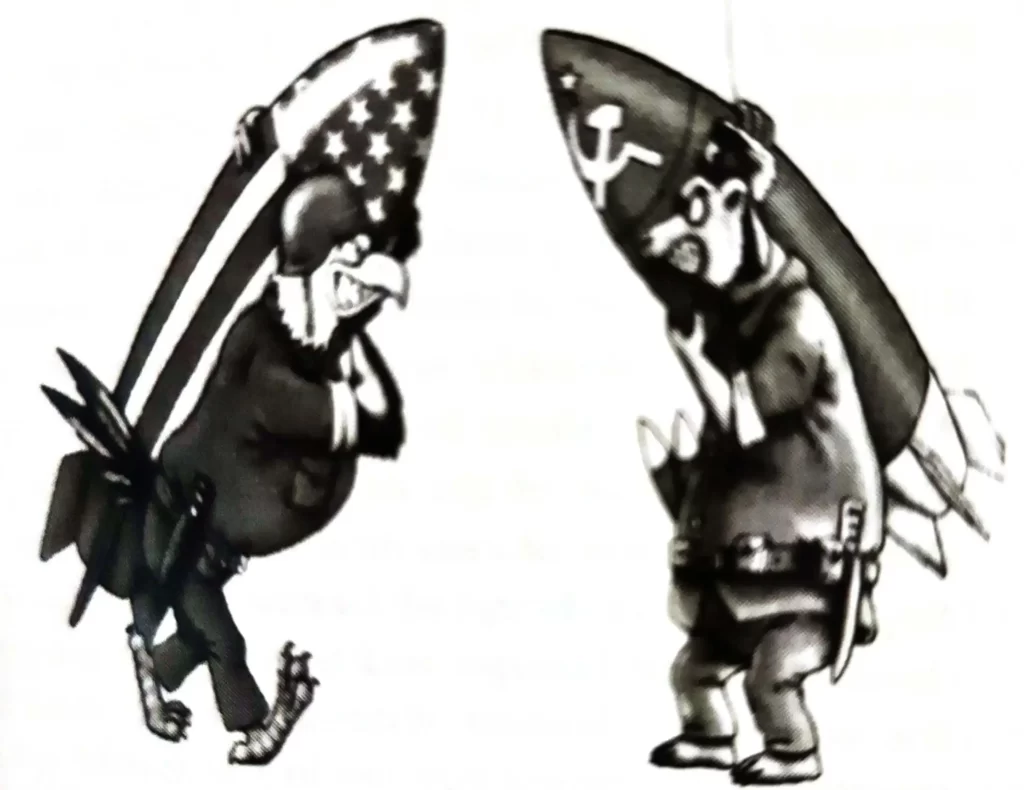
Q. l. What could be the appropriate title for the picture given above?
(A) US vs USSR economic contestation
(B) Capitalist vs Communist Model
(C) Contestation between two superpowers; US vs USSR
(D) Cuban Missile Crisis
Ans. (C)
Explanation: The main enemies were the United States and the Soviet Union. The Cold War got its name because both sides were afraid of fighting each other directly.
In a “hot war,” nuclear weapons might destroy everything. So, instead, both sides fought a proxy war. The proxy warfare was motivated by fears that a conventional war between the United States and the Soviet Union would result in nuclear holocaust.
Q. 2. How does the USA shows its hegemony?
(A) By showing its dominance in military, economy and culture over the other nations.
(B) By having the UN headquarter in New York.
(C) By cooperating with other nations in their development.
(D) None of the above.
Ans. (A)
Q. 3. Name two allied countries each of these superpowers.
(A) Albania and Romania
(B) New Zealand and China
(C) India and Nepal
(D) France and Canada
Ans. (D)
Q. 4. What was the result of the Cold War?
(A) Disintegration of USSR and US emerging as the sole superpower,
(B) Beginning of Russian dominance over the world.
(C) Fall of the US as a capitalist economy and its adoption of Communist model
(D) None of the above.
Ans. (A)
Explanation: During 1989 and 190, the Berlin Wall came down, borders opened, and free elections ousted Communist regimes everywhere in eastern Europe. In late 191 the Soviet Union itself dissolved, into its component republics. With stunning speed, the Iron Curtain was lifted and the Cold War came to an end.
Il. Read the following passage carefully and answer the questions that follow:
In April 1961, the leaders of the Union of Soviet Socialist Republics (USSR) were worried that the United States of America (USA) would invade communist-ruled Cuba and overthrow Fidel Castro, the president of the small island nation off the coast of the United States.
Cuba was an ally of the Soviet Union and received both diplomatic and financial aid from it.
Nikita, the leader of the Soviet Union, decided to convert Cuba into a Russian base. In 1962, he placed nuclear missiles in Cuba.
The installation of these weapons put the US, for the first time, under fire from close range and nearly doubled the number of bases or cities in the American mainland which could be threatened by the USSR.
Three weeks after the Soviet Union had placed the nuclear weapons in Cuba, the Americans became aware of it.
The US President, John F. Kennedy, and his advisers were reluctant to do anything that might lead to full-scale nuclear war between the two countries, but they were determined to get Khrushchev to remove the missiles and nuclear weapons from Cuba.
Kennedy ordered American warships to intercept any Soviet ships heading to Cuba as a way of warning the USSR of his seriousness.
A clash seemed imminent in what came to be known as the Cuban Missile Crisis. The prospects of this clash made the whole world nervous, for it would have been no ordinary war.
Eventually, to the world’s great relief, both sides decided to avoid war. The Soviet ships slowed down and turned back.
Q. I, The leaders of the Union of Soviet Socialist Republics (USSR) were worried that…
(A) the USA would invade communist-ruled Cuba and overthrow Guevara.
(B) the USA would invade communist-ruled Cuba and overthrow Fidel Castro.
(C) the USA would invade communist-ruled Cuba to establish democratic government,
(D) All of the above.
Ans. (B)
Explanation: April 1961, the leaders of the Union of Soviet Socialist Republics (USSR) were worried that the United States Of America (USA) would invade communist-ruled Cuba and overthrow Fidel Castro, the President Of the small island nation off the coast Of the United States. In 1962, he placed nuclear missiles in Cuba.
Q. 2. From whom did Cuba receive diplomatic and financial help?
(A) Fidel Castro
(B) United Nations
(C) Soviet Union
(D) John F Kennedy
Ans. (C)
Explanation: Cuba became increasingly dependent on Soviet markets and military and economic aid. Castro was able to build a formidable military force with the help of Soviet equipment and military advisors.
Q. 3. Who decided to convert Cuba into a Russian base?
(A) Nikita Khrushchev
(B) Fidel Castro
(C) America
(D) None of the above
Ans. (A)
Explanation: In response to the presence of American Jupiter ballistic missiles in Italy and Turkey, and the failed Bay of Pigs Invasion of 1961, Soviet First Secretary Nikita Khrushchev agreed to Cuba’s request to place nuclear missiles on the island to deter a future invasion.
Q. 4. Who ordered American warships to intercept any Soviet ships heading to Cuba as a way of warning to USSR?
(A) George W Bush
(B) Western European countries
(C) John F Kennedy
(D) All the above
Ans. (C)
Explanation: In 1962, President John F. Kennedy imposed a U.S. naval blockade of Cuba after U.S. spy planes found Soviet missile sites on the Communist-ruled island,
Ill. Read the following passage carefully and answer die quesüons that follow:
The end of the Second World War is a landmark in contemporary world politics. In 1945, the Allied Forces, led by the US, Soviet Union, Britain and France defeated the Axis Powers led by Germany, Italy and Japan, ending the Second World War (1939- 1945).
The war had involved almost all the major powers of the world and spread out to regions outside Europe including Southeast Asia, China, Burma (now Myanmar) and parts of India’s northeast.
The war devastated the world in terms of loss of human lives and civilian property. The First World War had earlier shaken the world between 1914 and 1918.
The end of the Second World War was also the beginning of the Cold War. The world war ended when the United States dropped two atomic bombs on the Japanese cities of Hiroshima and Nagaoaki in August 1945t causing Japan to surrender.
Critics of the US decision to drop the bombs have argued that the US knew that Japan wag about to surrender and that it was unnecessary fo drop the bombs.
They suggest that the US action was intended to stop the Soviet Union from making military and political gains in Asia and elsewhere and to show Moscow that the United States was supreme.
US supporters have argued that the dropping of the atomic bombs was necessary to end the war quickly and to Stop further loss of American and Allied lives.
Whatever the motives, the consequence of the end of the Second World War was the rise of two new powers on the global stage.
With the defeat of Germany and Japan, the devastation of Europe and in many other parts of the world, the United States and the Soviet Union became the greatest powers in the world with the ability to influence events anywhere on earth.
Q. 1. Which countries comprised the “allied forces”?
(A) US, Soviet Union, Britain and France.
(B) US, Germany, Soviet Union and Britain.
(C) US, Soviet Union, Britain, France and Japan.
(D) None of the above
Ans. (A)
Explanation: The major Allied Powers were Britain, France, Russia, and the United States. The Allies formed mostly as a defence against the attacks of the Axis Powers, The original members of the Allies included Great Britain, France and Poland.
Q. 2. How long did the Second World War last?
(A) five years
(B) seven years
(C) three years
(D) six years
Ans. (D)
Explanation: Lasting six years and one day, the Second World War started in September 1939 with Hitler’s invasion of Poland and ended with the Japanese surrender on 2 September 1945.
Q. 3. When did the First World War start?
(A) 1914 (B) 1918
(C) 1915 (D) 1920
Ans. (A)
Q. 4. What is the critics’ opinion about USA dropping the atomic bombs on Japan?
(A) USA was completely unaware that Japan was
about to surrender.
(B) The USA already knew that Japan was going to surrender.
(C) USA wanted to control Japan as its colony
(D) USA wanted to capture Japan’s natural resources.
Ans. (B)
IV. Read the following passage carefully and answer the questions that follow:
The Western alliance was formalized into an organization, the North Atlantic Treaty Organization (NATO), which came into existence in April 1949. It was an association of twelve states which declared that armed attack on any one of them in Europe or North America would be regarded as an attack on all of them.
Each of these states would be obliged to help the other. The eastern alliance, known as the Warsaw Pact, was led by the Soviet Union. It was created in 1955 and its principal function was to counter NATO’s forces in Europe.
International alliances during the Cold War era were determined by the requirements of the superpowers and the calculaüons of the smaller states. As noted above, Europe became the main arena of conflict between the superpowers.
In some cases, the superpowers used their military power to bring countries into their respective alliances. Soviet intervention in east Europe provides an example. The Soviet Union used its influence in eastern Europe, backed by the very large presence of its armies in the countries of the region, to ensure that the eastern half of Europe remained within its sphere of influence.
In East and Southeast Asia and in West Asia (Middle East), the United States built an alliance system called — the Southeast Asian Treaty Organization (SEATO) and the Central Treaty Organization 1 (CENTO). The Soviet Union and communist China responded by having close relations with regional countries such as North Vietnam, North Korea and Iraq.
Q. 1. When was NATO formed?
(A) June 1949
(B) March 1949
(C) February 1949
(D) April 1949
Ans. (D)
Explanation: The North Atlantic Treaty Organization was created in 1949 to provide collective security against the Soviet Union.
Q. 2. How many states were associated with NATO?
(A) eleven states
(B) twelve states
(C) ten states
(D) nine states
Ans. (B)
Q. 3. When was the Warsaw Pact created?
(A) 1955 (B) 1957
(C) 1954 (D) 1956
Ans. (A)
Explanation: The Warsaw Pact was created in reacåon to the integration of West Germany into NATO in 1955 per the London and Paris Conferences of 1954. The Warsaw Pact was established as a balance of power or counterweight to NATO,
Q, 4. What was the primary aim of the Warsaw Pact?
(A) To counter USA’s forces only
(B) To counter SEATO’s forces
(C) To achieve economic development in the countries of Soviet Union
(D) To counter NATO’s forces in Europe
Ans. (D)
Explanation: The primary aims of the Warsaw Pact were to safeguard the security of its member states and to increase military cooperation amongst its members.
Political Science All Chapter Notes
- Class 12 Political Science Syllabus
- Chapter 1: Cold War Era
- Chapter 2: The End of Bipolarity
- Chapter 3: New Centre Of Power
- Chapter 4: South Asia and The Contemporary World
- Chapter 5: United Nation And Its Organisations
- Chapter 6: Globalization
- Chapter 7: Challenge Of Nation Building
- Chapter 8: Planned Development
- Chapter 9: India’s Foreign Policy
- Chapter 10: Parties And The Party Systems In India
- Chapter 11: Democratic Resurgence
- Chapter 12: Indian Politics: Trends And Developments
Final Words
From the above article, you have practiced Class 12 Cold War Era MCQ Chapter 1. We hope that the above-mentioned MCQs for term 1 of will surely help you in your exam.
If you have any doubts or queries regarding Class 12 Cold War Era MCQ (Multiple Choice Questions) with Answers, feel free to reach us and we will get back to you as early as possible.