Last updated on July 14th, 2024 at 06:03 am
UGC NET Physical Education Unit 4 Notes
Dear all, if you want to prepare for ugc net Physical Education unit 4 notes for final paper and want to clear the exam in the first attempt then you are at the right place.
In the article you will get Nta Ugc Net Physical Education unit 4 notes, question answers of unit 4 which are based on previous years papers.
You will also get ugc net Physical Education unit 4 notes Pdf Download in English, ugc net study material for Physical Education, ugc net Physical Education unit wise notes, ugc net Physical Education free study notes in English, ugc net Physical Education topic wise questions, ugc net Physical Education last 10 years solved papers.
This UGC NET Physical Education Unit 4 notes has been prepared by Expert faculties based on the latest Syllabus. You will get latest and tricky Question answers, which will definitely help you to get excellent position
Psychology of Teaching And Learning
Psychology
Psychology is an academic and scientific study of mental processes and behavior. Psychologists study such concepts as perception, cognition, emotion, personality, behavior, interpersonal relationships, and the individual and collective unconscious.
Psychology also refers to the application of such knowledge to various spheres of human activity including issues related to daily life—e.g. family, education, and work—and the treatment of mental health problems.
Psychology includes many sub-fields of study and application concerned with such areas as human development, sports, health, industry, media, law.
Psychology is the science of the intellects, characters and behavior of animals including man. Human education is concerned with certain changes in the intellects, characters and behavior of men, its problems being roughly included under these four topics: Aims, materials, means and methods.
Meaning of Psychology
Psyche = soul, mind.
Logos = word, science, study, discourse. Psychology as the science of soul.
Psychology as the science of mind.
Psychology as the science of consciousness.
Psychology as the science of behavior.
Definition of Psychology
W. B. Kolesnik:
“Psychology is the science of human behavior.”
Good defines :
“Psychology is the study of adjustments of organism, especially the human organism to change the environment.”
Major Branches of Psychology
Abnormal psychology deals with behavior disorders and disturbed individuals. For example, researchers might investigate the causes of violent or self-destructive behavior or the effectiveness of procedures used in treating an emotional disturbance.
Clinical psychology uses the understandings derived from developmental and abnormal psychology to diagnose and treat mental disorders and adjustment problems.
Comparative psychology explores the differences and similarities in the behavior of animals of different species.
Developmental psychology studies the emotional, intellectual, and social changes that occur across the life span of human beings.
Educational psychology attempts to improve teaching methods and materials, to solve learning problems, and to measure learning ability and educational progress.
Social psychology studies the social behavior of individuals and groups, with special emphasis on how behavior is affected by the presence or influence of other people.
Educational Psychology
Education: has its Latin root:
“educere” = to lead out,
to draw out
– the innate capacities in man.
“educare” = to bring up,
to raise.
– from one level to another.
“educatum” = the act of teaching/training.
Definitions of Education:
Swami Vivekananda defines: “Education is the manifestation of perfection already present in man.”
Mahatma Gandhi defines: “By Education, I mean, an all round drawing out of the best in the child and man – body, mind and spirit.”
Froebel: Education is a process by which the child makes the internal external.
John Dewey defines: “Education is life, life is education”.
According to Pestalozzi, “Education is a natural, harmonious, progressive development of man’s innate powers.’
Definitions of Educational Psychology
C.V. Good : “Educational psychology is (i) the investigation of psychological problems involved in education, together with the practical application of psychological principles to education (ii) a study of nature of learning.”
J.M. Stephon : “Educational Psychology is a systematic study of educational growth.”
Crow and Crow, “Educational Psychology describes and explains the learning experiences of an individual from birth through old age.”
Scope of Psychology
A committee set up by the Department of Educational Psychology in the American Scientific Council has given the following areas covered by Educational Psychology:
- Human Growth and Development
- Learning
- Personality and Adjustment
- Measurement and Evaluation
- Techniques and Methods of study
Utility / Usefulness of Edu. Psychology
Psychology is useful in –
(i) Educational administration
(ii) in the curriculum
(iii) in the teacher training
It helps to answer the questions:
(i) When to teach
(ii) What to teach
(iii) How of the learning process
(vi) Why of the learning process
Relationship between Education and Psychology:
Both are related to behavior
Psychology achieves the aims of education The Problems of Edu & Psychology are same
Close relationship b/w Teacher & Psychologist
Stress, Arousal, Anxiety, Aggression And Their Theories
Lazarus defines an emotion as “ an organized psychophysiological reaction to ongoing relationships with the environment, most often, but not always, interpersonal or social”.
He identifies 15 different emotions.
Stress
“It is the body’s reaction to a change that requires physical, mental or emotional adjustment or response”.
According to Hans selye (1983) defines stress as the “non- specific response of the body to any demand made upon it”.
Some people may become more aggressive, others may find their level of arousal is increased when they are stressed.
Excitement can lead to tension. Tension can then lead to tight muscles that will in turn effect performance (this is a form of stress).
Stress is of two types –
1) eustress ( good)
2) distress (bad)
Arousal
“The level of readiness of an individual to perform a task”
What happens to your performance if your not ‘up for it?’
What happens if you are too ‘up for it?’.
Arousal is correlated with both anxiety and stress, but is not the same as either. A high level of stress and anxiety is associated with a high level of physio arousal.
Theories of Arousal
1) Drive theory ( developed by clark Hull 1943 & Spence 1966) –
It helps to explain the relationships between learning and arousal, and between performance and arousal.
performance = Arousal * skill level
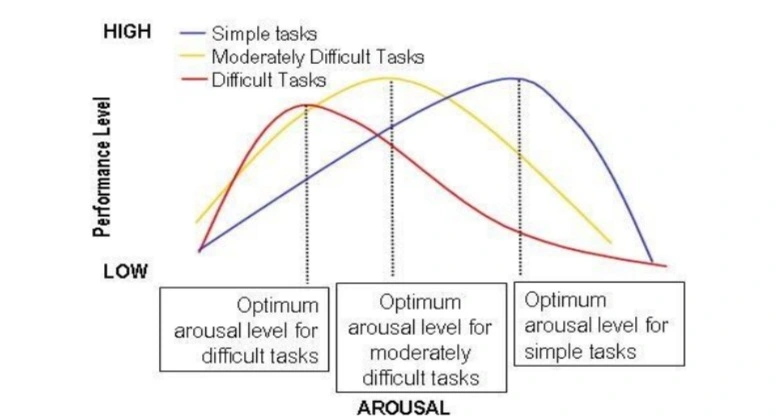
2) Inverted U theory – ( by Yerkes and Dodson 1908). Arousal is inversely proportional to performance.
3) Easterbrook’s Cue Utilization Theory– (By Easterbrook in 1959)- The basic premise of cue utilization theory is that as arousal increases, attention narrows.
4) Signal Detection theory (Peterson, Birdsall and Fox 1954) – It is the theory that predicts a curvilinear relationship between arousal and performance is SDT.
It predicts that increased decision errors will occur when an individual is either insensitive to a physical stimulus or super sensitive to physical stimulus.
Anxiety
‘When a person is uneasy or troubled, often caused by fear of
underperforming’
All performers experience some degree of anxiety before or during a performance. The level of anxiety will depend on the nature of the activity (if the stakes are high or if the crowd is large) and the personality of the individual.
One of these emotions is anxiety, which he defines as “facing uncertain, existential threat”.
How do you feel before competing for your team in a PE lesson?
When competing for the school?
If you were competing for the county?
If you were representing the country?
Types of Anxiety –
• Anxiety is multidimensional in different ways –
1) State Anxiety – It is an immediate emotional state that is characterized by apprehension, fear, tension and an increased physiological arousal.
2) Trait anxiety – it is predisposition to perceive certain environmental situations as threatening and to respond to these situations with increased state anxiety. Trait anxiety is a long process. Trait anxiety is a part of personality.
3) Cognitive anxiety – it is the mental component of anxiety caused by such things as a fear of negative social evaluation, fear of failure, and loss of self-esteem.
4) Somatic anxiety – It is the physical
component of anxiety and reflects the
perception of physiological responses as increased heart rate, respiration and muscular tension.
5) Competitive state anxiety – (explained by Endler) prior to competition.
Theories of Anxiety –
Multidimensional Anxiety Theory – By Martins et al., 1990) – This theory based upon motion that anxiety is multi- dimentional in nature, composed of a cognitive anxiety component and a somatic anxiety component.
Catastrophe theory – By Fazey and lew Hardy (1988 – 1991) Complex interaction of arousal and cognitive anxiety. As you thought anxiously you perform poorer. There is a breaking point when performance decreases dramatically.
IZOF (Individual Zone of Optimal Functional Theory) – By Yuri Hanin ( alternative of inverted U theory). He found that top athletes have a zone of optimal state anxiety in which their best performance occurs. Outside this zone, poor performance occurs.
Directionality Theory – By Jones and Swain (1995). Relationships between the intensity and directional aspects of competitive state anxiety.
Reversal Theory – by Apter (1982) and kerr (1985). It contends that the way in which arousal affects performance depends basically on an individual’s interpretation of his arousal level.
Social Physique Anxiety – The degree to which People become anxious when others observe their physique.
Aggression
What is aggression? Discuss this with you partner.
“Aggression is defined as behavior aimed at causing harm or pain, psychological harm, or personal injury or physical distraction.”
or
“Acting with intent to injury someone”
When does this occur in sport?
Do we really want players to play with more aggression?
There are 2 ways of aggression:
Direct – players make contact with each other
Indirect – aggression directed towards a ball/other object
Direct Aggression
Contact sports involve physical contact.
Indirect Aggression
You can still be aggressive in non-contact sports.
Controlled and uncontrolled aggression
Extroverted people are often involved in sports which require a degree of aggression. Aggression can be a negative, although as long as it is controlled, it can also become a positive.
Aggression can sometimes be the same as being assertive and determined, in non-contact sports especially, this is usually a good thing. In contact sports, aggression, if uncontrolled, can lead to rule breaking and injuring the opponent.
Types of aggression –
Hostile
Instrumental
Assertiveness
Click Below For All Games Measurements, Rules, history
- Basketball History, Rules, Measurement
- Athletics Hostory, Rules, Measurement
- Football History, Rules, Measurement
- Hockey History, Rules, Measurement
- Cricket History, Rules, Measurement
- Handball History, Rules, Measurement
- Gymnastic History, Rules, Measurement
- Volleyball History, Rules, Measurement
- Badminton History, Rules, Measurement
- Tennis History, Rules, Measurement
- Table Tennis Rules, Measurement
- Boxing Rules, History, Measurement
- Kho-Kho Rules, History, Measurement
- Kabaddi Rules, History, Measurement
- Taekwondo Rules, History, Measurement
- Judo Rules, History, Measurement
Theories of Aggression –
There are four main theories of aggression –
Instinct theory – Sigmund Freud (1950) He viewed aggression as an inborn drive similar to hunger, thirst and sexual desire. According to freud, aggression is unavoidable since it is innate.
Social learning theory by Albert bandura(1977)– Social learning theory states that individuals become aggressive by imitating role models. SLT states that observational learning takes place, and that this learning is reinforced vicariously.
Frustration- aggression hypothesis by John Dollard 1939, Psychological explanation of aggressive behavior as stemming from the frustration of goals.
Reformulated Frustration-Aggression theory – By Dollard, Miller, Doob, Sears (1939) He proposed that aggression is a natural response to frustration, and that the aggressive act purging of the anger associated with the frustration.
Sports Psychology
Different Theories And Their Names
Learning –
Learning is a complex process. It is the process of acquiring new understanding, knowledge, behaviors, skills, values, attitudes, and preferences.
Laws of learning (Edward Lee Thorndike- 1874-1949))–
Thorndike developed the first three “Laws of learning:” Readiness,Exercise and effect.
Law of readiness: It speaks about learners’ enthusiasm
Law of exercise: It is about repetition
Law of effect: It is about learners’ encouragement
Secondary or Subordinate Laws of Learning:
Thorndike gave the following Secondary laws also:
Law of Primacy:
‘Learning that takes place in the beginning is the best and lasting’. The learning on the first day is most vivid and strong.
Law of Recency:
‘Recent acts are lasting’. We remember those things better which are recent.
Law of Intensity of stimulus:
‘If a stimulus is strong, the response will be strong, and vice-versa.’
Law of Multiple Response:
Confronted with a new situation the organism responds in a variety of ways arriving at the correct response.
Law of Set Attitude:
The learner performs the task well if he has his attitude set in the task.
Law of Analogy and assimilation:
The organism makes responses by comparison or analogy and assimilation. When learner finds the similarities and dissimilarities in the lesson with daily experiences he earns better. Hence teaching must be correlated with life experiences.
Law of Associative Shifting:
According to this law we can get any response, from the learner of which he is capable, associated with any situation to which he is sensitive.
Law of Partial activity:
This law states that teaching should be done in parts. It is more true in the case of children’s
education.
What is Learning Curve ?
A learning curve is a correlation between a learner’s performance on a task and the number of attempts or time required to complete the task; this can be represented as a direct proportion on a graph.
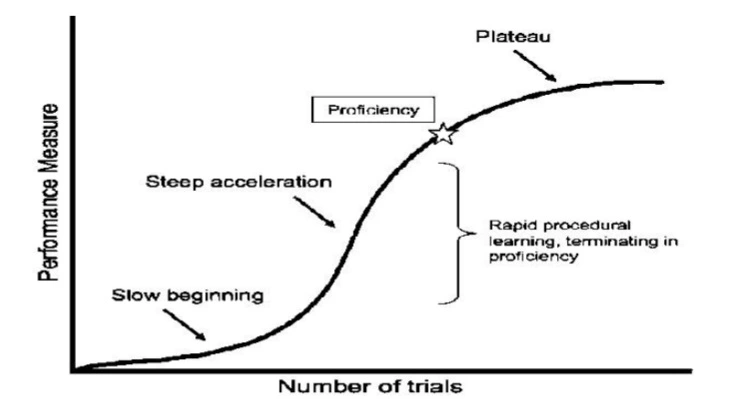
Where:
Y is the average time over the measured duration
a represents the time to complete the task the first time
X represents the total amount of attempts completed
b represents the slope of the function
Theories of learning – Theories of learning divided into –
Behaviourism – ( byB.F.Skinner), focus on observable behavior.
Cognition – (by wolfgangkohler), learning as purely a mental/neurological process.
Humanistic – (by Carl roger and Abraham Maslow), emotions and effect play a role in learning.
Social – (By clark hull), Human learn best in group activities.
Behaviorism
The two learning theories form the basis of applied behavior analysis –
1) Classical conditioning (also called Respondent conditioning and Stimulus- response theory) – (by Ivan Pavlov), in classical conditioning, it explains there is a response to an antecedent stimulus. Example – a dog secretes saliva over the bell).
2) Operant theory also called “Instrumental conditioning”- by B.F.Skinner.
This theory means changes in behavior are the result of an individual’s response to stimulus that occurs in environment. Strength of behavior is modified by its consequences, such as reward and punishment.
It reinforces the behavior with reward or punishment. There are four types of operant conditioning – positive, negative (both strengthening behavior) and punishment and extinction (both weakens theory).
Also known as Feedback/Reinforcement (Skinner’s Pigeon Box) – If you want to teach a pigeon to turn in a circle to the left, you give it a reward for any small movement it makes in that direction
Cognetivism
Knowledge is stored cognitively as symbols.
Learning is the process of connecting symbols in a meaningful & memorable way.
Studies focused on the mental processes that facilitate symbol connection.
1) Insight learning – By wolfgang kohler (1925).
Insight learning occurs when a new behavior is learned through cognitive processes rather than through interactions with the outside world. (chimpanzee and banana).
2) Discovery Learning – Jerome Bruner
Bruner said anybody can learn anything at any age, provided it is stated in terms they can understand.
3) Meaningful Verbal Learning -David Ausubel
New material is presented in a systematic way, and is connected to existing cognitive structures in a meaningful way.
Social Approch (Clark Hull)
Clark L. Hull, in full Clark Leonard Hull, American psychologist known for his experimental studies on learning and for his attempt to give mathematical expression to psychological theory.
The reinforcement theory of learning formed the basis for most of Hull’s work.
Hull wanted to establish the basic principles of behavioral science to explain the behavior of different animal species as well as individual and social behavior.
His theory is known as deductive behaviorism.
For Hull, strength of habit was the most basic concept. He believed that practice reinforced habits.
Hull described habits as stimulus-response connections based on rewards. According to Hull, responses, not perceptions or expectations, are what help form habits. The process is gradual and a reward is essential.
1) Hull’s deduction behaviorism theory –
Hull was one of the first theorists to try to create a theory designed to explain all behavior. This learning theory, developed by Hull in 1943, is known as drive reduction theory.
A drive, such as thirst, hunger, or cold, creates an unpleasant state or a tension. To reduce this state of tension, humans and animals seek ways to meet these biological needs (drinking, eating, finding shelter). In this sense, Hull suggested that humans and animals repeat any behavior that reduces these impulses.
2) Social learning theory– by Albert Bandura in 1973. Learns by seeing and watching.
In social learning theory, Albert Bandura (1977) agrees with the behaviorist learning theories of classical conditioning and operant conditioning.
However, he adds two important ideas:
- Mediating processes occur between stimuli & responses.
- Behavior is learned from the environment through the process of observational learning.
There are four mediational processes proposed by Bandura:
- Attention: The extent to which we are exposed/notice the behavior.
- Retention: How well the behavior is remembered.
- Reproduction: This is the ability to perform the behavior that the model has just demonstrated.
- Motivation: The will to perform the behavior. The rewards and punishment that follow a behavior will be considered by the observer.
Humanistic Approach
Humanism rejected the assumptions of the behaviorist perspective which is characterized as deterministic, focused on reinforcement of stimulus-response behavior and heavily dependent on animal research.
Humanistic psychology also rejected the psychodynamic approach because it is also deterministic, with unconscious irrational and instinctive forces determining human thought and behavior.
Basic Assumptions
- Humans have free will; not all behavior is determined.
- All individuals are unique and are motivated to achieve their potential.
- A proper understanding of human behavior can only be achieved by studying humans – not animals. Psychology should study the individual case (idiographic) rather than the average performance of groups (nomothetic).
Other theories of learning are –
- Gestalt theory (by Kurt koffa, wolfgangkohler)– Instead of obtaining knowledge from what’s in front of us, we often learn by making sense of the relationship between what’s new and old.
- Transformative learning theory (By Jack Mezirow) – it explains how human revise and reinterpret meaning. It is a cognitive process of effective change in a frame of reference.
- Trial and Error theory – By E.L. Thorndike
- Item response theory or Latent Trait theory – A theory that focuses on the characteristics of a test item and the examinee’s response to the itemas a means of determining the examinee’s ability.
- Contiguity theory – Edwin Guthrie.
In contiguity theory, rewards or punishment play no significant role in learning since they occur after the association between stimulus and response has been made.
According to Guthrie, all learning was a consequence of association between a particular stimulus and response. Furthermore, Guthrie argued that stimuli and responses affect specific sensory-motor patterns; what is learned are movements, not behaviors.
Theories of Personality
The word ‘personality’ derives from the Latin word ‘persona’ which means ‘mask’. The study of personality can be understood as the study of ‘masks’ that people. wear.
The sum total of ways in which an individual reacts and interacts with others.A relatively stable set of characteristics that influences an individual’s behavior.
“Personality as that which tells what man will do when placed in a given situation”. It is the sum of characteristics which make the person unique.
Personality Determinants:
Heredity
Environment
Situation
Culture
Family and social background
Previously it was four theories – a) Trait theory b) Psychodynamic theory c) Humanistic theory d) integrative approach.
Personality traits – A personality trait is a personality characteristic that endures over time and across different situations. Focuses on measuring, identifying and describing individual differences in personality in terms of traits.
Personality types are sometimes distinguished from personality traits.
(A) Trait Theory of Personality–
(Gordon Allport, 1960-70)
Trait theories of personality focus on measuring, identifying and describing individual differences in personality in terms of traits
Modification of Trait theory – Raymond Cattle and Hans Eysenck cattle (1965) identifies 35 different traits that he believed describes a personality by the 16 PF measurement.
Carl Jung Typology
The theory of psychological type was introduced in the 1920s by Carl G. Jung.
One of the more influential ideas originated in the theoretical work of Carl Jung and the theory developed by him was Carl jung typology.
He grew from his desire to reconcile the theories of Sigmund Freud and Alfred Adler, and to define how his own perspective differed from theirs.
Personality Types
Extroverted vs. Introverted (E or I) Sensing vs. Intuitive (S or N) Thinking vs. Feeling (T or F) Judging vs. Perceiving (P or J)
Myers Briggs Questionnaire
The Myers–Briggs Type Indicator (MBTI) is a pseudoscientific introspective self- report questionnaire indicating differing psychological preferences in how people perceive the world and make decisions.
In developing the Myers-Briggs Type Indicator [instrument], the aim of Is bel Briggs Myers, and her mother, Katharine Briggs, was to make the insights of type theory accessible to individuals and groups. The original research was done in the 1940s and ’50s.First published in 1962.
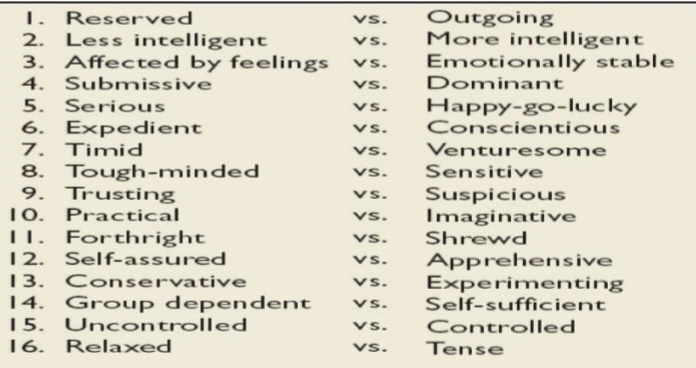
Most researchers now believe that it is impossible to explain the diversity of human personality with a small number of discrete types. They recommend trait models instead, such as the five-factor model.
BIG FIVE personality traits –
Extroversion
This trait includes characteristics such as excitability, sociability, talkativeness, assertiveness, and high amounts of emotional expressiveness.
Sociable, gregarious, and assertive
I love excitement and am a cheerful person.
Agreeableness
This personality dimension includes attributes such as trust, altruism, kindness, affection, and other prosocialbehaviors.
Good-natured, cooperative, and trusting. People find me warm and generous and selfless
Conscientiousness
Common features of this dimension include high levels of thoughtfulness, with good impulse control and goal-directed behaviors
Responsible, dependable, persistent, and organized. People find me reliable and I keep my house clean
Emotional Stability
Individuals high in this trait tend to experience emotional instability, anxiety, moodiness, irritability, and sadness.
calm, self-confident, secure (positive) versus nervous, depressed, and insecure (negative).
I am very moody I often feel sad and down
Openness to Experience
This trait features characteristics such as imagination and insight, and those high in this trait also tend to have a broad range of interests.
I am a very curious person & enjoy challenges Imaginativeness, artistic, sensitivity, and intellectualism.
B) Psychodynamic Theory
(By Sigmund Freud in1933 and also Carl Jung and Eric Erinson) .
Much of behavior is motivated by inner forces, conflicts and memories of which a person has little awareness of control. Freud used the analogy of the iceberg to depict the consciousness and unconscious mind. Freud believed that only 10% of personality is available to consciousness awareness.
Divided into three –
ID-
Instinctual energy (unconsciousness) -Satisfaction is the ultimate goal
Raw, unorganized, inborn part of personality
Primitive desires of hunger, sex, and aggression
Pleasure Principle
Reality Principle: Instinctual energy (ID) is restrained in order to maintain the safety of the individual and keep him/her within societies norms
EGO – The conscious personality
SUPEREGO – Moral Consciousness
Right and wrong
Develops at age 5 or
Learned from others
Moral Ideals and Conscience
–Guides us toward socially acceptable behavior through the use of guilt and anxiety
The cost of advanced civilization is the sense of guilt.
–Sigmund Freud, Civilization and Its Discontents
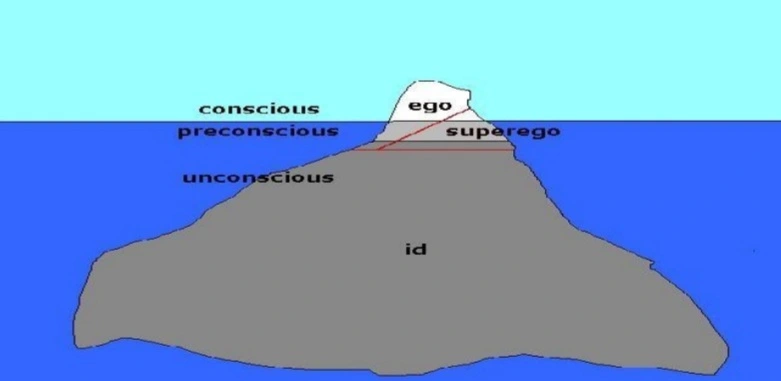
Freud’s theory outlines three mental components:
Id : Hedonistic
Ego: Realistic
Superego: Moralistic
A. Components of the Psyche: The Id
Unconscious; operates according to the pleasure principle with no regard for moral principles
Primary process thinking achieves momentary satisfaction and wish fulfillment
Insight (catharsis) reduces tension
Freud termed the libido ‘eros’, and termed aggression ‘thanatos’.
B. Components of the Psyche: The Ego
Mostly conscious; operates according to the reality principle
Tries to align the urge of the id with reality using secondary process thinking
The ego considers the situation and past experience to engage in behavior.
C. Components of the Psyche: The Superego
Mostly conscious; operates according to the perfection principle
Tries to uphold morality by a strict adherence to societal standards
Guilt and shame result from immoral behavior for those having a strong superego
C) The Humanistic Approach (by Carl Roger (1946) and Abraham Maslow(1943))-
Self-awareness is the art at the core of humanity. People are free to do as they chose with their lives and are responsible for the decisions they make.
People are free to do as they choose with their lives and, as such, are responsible for the decisions they make.
Very different approach from the behaviorists – much more optimistic.
Believed that humans are separated from lower animals because they recognize their desire to achieve self-actualization – to reach their full potential
People are unique – must follow their own paths to self-actualization
Involves risk – easier to stay with the tried and true
D) Integrative Approach
Stressed by personality psychologists ranging from Murray andEysenck to McAdams and Mayer.
An integrative approach is necessary to fulfill the mandate of personality psychology to explain the whole person, including Behavior, cognition and social value.
Also Read: UGC NET Physical Education Unit 1 Notes
Other Theories of Personality
Phenomenological or self-theory – (by Carl Rogers)
This theory explains the consistency between self-concept and one’s experiences. Human nature is optimistic.
People are the conscious architects of their own personality through free choice/action
(Self Theory) Emphasizes human ability to derive self-concept
– The Self as an Individual
– One’s values and relationship with others
Self-actualization theory – Abraham Maslow
Self –Concept theory of personality – Carl Rogers.
Personal construct theory of personality – George Kelley
Social Evaluation theory – Festinger (1954)
Sometimes the success of others is a source of good feelings. Sometimes the accomplishments of friends are threatening and may even disrupt the relationships. These kinds of complex interpersonal dynamics are the focus of the self-evaluation maintenance (SEM) model.
Self- Efficiency theory – By Albert Bandura.
The perception of one’s ability to perform a task successfully is really a situation-specific form of self-confidence.
Theory of Motivation
– The process that initiates, directs, and sustains behavior to satisfy physiological or psychological needs or wants
– Psychologists generally break motivation down into three processes: activation, persistence, and intensity.
Activation: Is the initiation of motivated behavior.
Persistence : is the faithful and continued effort put forth in order to achieve a goal or finish a project.
Intensity : Refers to the focused energy and attention applied in order to achieve a goal or complete a project.
Motives: Needs or desires that energize and direct behavior toward a goal
Intrinsic motivation: The desire to perform an act because it is satisfying or pleasurable in and of itself
Extrinsic motivation: The desire to perform an act to gain a reward or to avoid an undesirable consequence
Incentive: An external stimulus that motivates behavior
Maslow’s hierarchy of needs is a theory by Abraham Maslow, which puts forward that people are motivated by five basic categories of needs: physiological, safety, love, esteem, and self-actualization.
– He first proposed in 1943 paper “A Theory of Human Motivation” in Psychological ReviewMaslow’s theory was fully expressed in his 1954 book Motivation and Personality
– Clayton Paul Alderfer is an American psychologist who developed Maslow’s hierarchy of needs into a theory of his own. Alderfer’s ERG theory suggests that there are three groups of core needs: existence (E), relatedness (R), and growth (G)—hence the acronym ERG.
Existence Needs
Include all material and physiological desires (e.g., food, water, air, clothing, safety, physical love and affection). Maslow’s first t o levels.
Relatedness Needs
Encompass social and external esteem; relationships with significant others like family, friends, co-workers and employers . This als means to be recognized and feel secure as part of a group or family. Maslow’s third and fourth levels.
Growth Needs
Internal esteem and self actualization; these impel a person to make creative or productive effects on himself and the environment (e.g., to progress toward one’s ideal self).
Theories Of Motivation
Acquired Need Achievement theory – McClelland in the year 1961 and Atkinson in 1974. It means some needs are acquired as a result of life experiences.
Cognitive evaluation theory – by Deci and Ryan 1985– this theory states that there are actually two motivational systems. – 1) Intrinsic and extrinsic.
Two factors theory –Frederick Herzberg in 1959.
It states that there are two factors which affect motivation.
Hygiene factor – these are factors whose absence motivates.
Motivators – these are factors whose presence motivates.
Equity theory – equity theory was first developed in the 1960s by J. Stacy Adams, who asserted that employees seek to maintain equity between the inputs that they bring to a job and the outcomes that they receive from it against the perceived inputs and outcomes of others.
Reinforcement theory –Behaviorist B.F. Skinner derived the reinforcement theory, one of the oldest theories of motivation, as a way to explain behavior and why we do what we do.
The theory states that “an individual’s behavior is a function of its consequences”.
Two types of reinforcement –
a) Positive reinforcement is “Any pleasant or desirable consequences that follows a response and increases the possibility that the response will be repeated”
b) Negative reinforcement is a “psychological reinforcement by the removal of an unpleasant stimulus when a desired response occurs”
Expectancy theory
In 1964, Victor H. Vroom developed the expectancy theory.
Expectancy theory proposes that an individual will behave or act in a certain way because they are motivated to select a specific behavior over others due to what they expect the result of that selected behavior will be.
Attribution theory of Motivation – Fritz Heider (1958)
This theory is concerned with ways in which people explain or attribute the behavior of others. Changes would be internal and external.is concerned with the ways in which people explain (or attribute) the behavior of others.
The theory divides the way people attribute causes to events into two types. External or “situational” attributions assign causality to an outside factor, such as the weather. Internal or “dispositional” attributions assign causality to factors within the person, such as ability or personality.
Instinct theories – McDougall
– The notion that human behavior is motivated by certain innate tendencies, or instincts, shared by all individuals
McDougall listed seventeen instincts in 1932, including hunger, rejection of particular substances, curiosity, escape, pugnacity, sex, maternal /paternal instinct, gregariousness, self-assertion, submission, construction, acquisition, crying out or appeal, laughter, comfort, rest or sleep, and migration.
Sigmund Freud
Psychiatrist Sigmund Freud suggested that human behavior was driven by two key forces
Life instincts (eros) – engaging in sex, eating, and other activities to be alive
Death instincts (thanatos) – engaging in aggressive behaviors like fights, stunts, not caring about survival.
Drive-Reduction theory( By Clark Hull 1943)- it is a type of motivational theory that explains that the presence of the audience causes arousal which creates dominant or typical response in the context of situation.
Arousal theory – (by Yerkes-Dodson in 1908)
– Motivation: is higher if arousal is higher.A theory suggesting that the aim of motivation is to maintain an optimal level of arousal
– Arousal : A state of alertness and mental and physical activation
Self-efficacy theory – By Bandura (1997)
He defines self-efficacy as “belief in one’s capabilities to organize and execute the course of action required to produce given attainment.
Competence motivation theory – By Susan Harter (1978 or 1988)
Goal Perspective theory – by Nicholl Acc. To him the defining feature of achievement theory of motivation is a way children come to view their own perceived ability. In goal perspective theory, the nature of perceived ability changes initially as a function.
Achievement Goal theory – (by Duda and Hull 2001)
It is a theory of achievement motivation that is based on an athlete’s feeling of personal competence. According to Harter, individuals are innately motivated to be competent in all areas of human achievements.
To satisfy the urge to be competent in an achievement area such as sport, the person attempts mastery. As the competence motivation increases, mastery attempts are more encouraged.
Three factors interact to a person’s motivation-achievement goals, perceived ability, achievement behavior, development level of the child and Cognitive restructuring.
Extra Theories
Theory of evolution – Charles Darwin
In 1858 Charles Darwin and Alfred Russel Wallace published a new evolutionary theory.
Instinct theory – Charles Darwin
Self-perception theory – (Daryl Bem 1960)-emphasizes that we observe ourselves in the same manner that we observe others, and draw conclusions about our likes and dislikes. Extrinsic self- perceptions can lead to the over-justification effect.
Schemata theory – Bartlett in 1932 and further developed in the ’70s by Richard Anderson
Focuses on “schemas” which are cognitive structures that organize knowledge and guide information processing. They take the form of generalized beliefs that can operate automatically and lead to biases in perception and memory.
Self-verification theory – Prescott Lecky (1945)
Focuses on people’s desire to be known and understood by others. The key assumption is that once people develop firmly held beliefs about themselves, they come to prefer that others see them as they see themselves.
Social comparison theory –Leon Festinger in his 1954
Suggests that humans gain information about themselves, and make inferences that are relevant to self-esteem, by comparison to relevant others.
Social exchange theory – By Homans (1961)
It is an economic social theory that assumes human relationships are based on rational choice and cost-benefit analyses. If one partner’s costs begin to outweigh his or her benefits, that person may leave the relationship, especially if there are good alternatives available.
Social identity theory –was developed by Henri Tajfel(Tajfel, 1978; Tajfel& Turner, 1979)
He examines how categorizing people (including oneself) into ingroups or outgroups affects perceptions, attitudes, and behavior.
Social penetration theory –
Proposes that, as relationships develop, interpersonal communication moves from relatively shallow, non-intimate levels to deeper, more intimate ones.
The theory was formulated by psychologists Irwin Altman and Dalmas Taylor in 1973 to provide an understanding of the closeness between two individuals.
Triangular theory of love – by Sternberg in the late 1980,
Characterizes love in an interpersonal relationship on three different scales: intimacy, passion, and commitment. Different stages and types of love can be categorized by different combinations of these three elements.
Social Facilitation theory – By Zajonc, 1965 which shows the effect of the audience on athletes.
Theory of Perception
Perception is the process by which the brain interprets and makes sense of the information, which it receives from the sense organs.
Gestalt theory – Max Wertheimer (1880–1943), Kurt Koffka (1886–1941), and (1887– 1967) founded Gestalt psychology in the early 20th century.
A group of German psychologists have done much research in learning, perception etc. Gestalt is a German word which means “whole”. They found out how sensory stimuli are organized into meaningful shapes and patterns. To them the whole is greater than some of its parts.
The Gestalt Theory is based upon the idea that our eyes perceive things as a whole, before recognizing individual elements.
They have proposed 6 laws of form perception. They are –
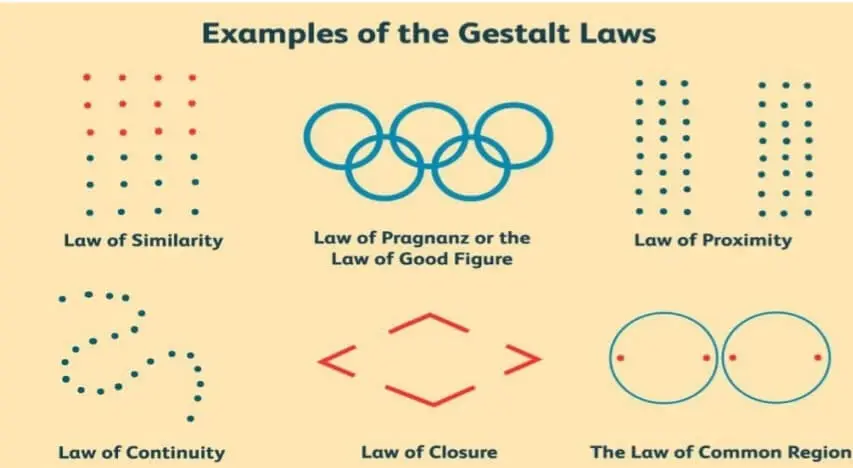
Similarity– The law of similarity suggests that similar things tend to appear grouped together. Grouping can occur in both visual and auditory stimuli. In the image above, for example, you probably see the groupings of colored circles as rows rather than just a collection of dots.
Proximity – According to the law of proximity, things that are near each other seem to be grouped together.In the above image, the circles on the left appear to be part of one grouping while those on the right appear to be part of another. Because the objects are close to each other, we group them together.
Simplicity– Images that may be complex or vague are viewed in the simplest of terms.
The Law of Simplicity is also known as the Law of Pragnanz.Continuity – The law of continuity holds that points that are connected by straight or curving lines are seen in a way that follows the smoothest path. Rather than seeing separate lines and angles, lines are seen as belonging together.
Law of Common Fate or region – When visual elements are all moving in the same direction at the same rate, our minds automatically assume that they are part of the same origin or stimulus.
Law of closure– According to the, things are grouped together if they seem to complete some entity. Our brains often ignore contradictory information and fill in gaps in information.
In the image above, you probably see the shapes of a circle and rectangle because your brain fills in the missing gaps in order to create a meaningful image.
Witkins theory by Herman A. Witkin(1950)- According to witkin’s theory experience plays a significant role in their present perception.
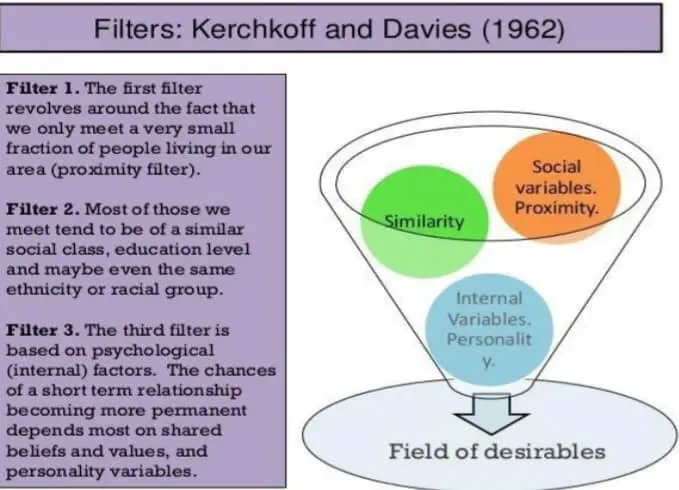
Filter theory –by Kerchoff and Davies (1962).
This theory suggests that people develop relationships by applying a series of filters, such as similarity of social demographic factors and attitudes and complementarity of needs to narrow down the pool of available candidates.
Technical, Tactical and Psychological Preparation (non-fitness components of sports training)
Technical Preparation
The aim of technical preparation is to create and improve sports skills. Each sports skill has a given way of solving a motor task (contents of a sports skill) in accordance with the rules of a given sport, biomechanical rules and locomotive possibilities of the athlete which are referred to as technique. Specific individual adjustment of technique by an athlete is referred to as style.
Procedure of acquiring motor skills:
- Sports skills are created on the basis of information on external and internal environment of the athlete and their synthesis into a complex image about the situation (skill) to be solved.
- Creating such an image is carried out on the basis of information acquired from senses (visual, audio, locomotive and positional) – perception.
- By repeating, perceived situations are gradually being fixed into corresponding perception patterns.
- Through afferent pathways, files with such information are transferred to CNS where they are further analyzed in programming processes.
- It is here that the neural basis of relevant programs is formed.
- The program is stored in the relevant memory.
- Selected solution program is implemented by relevant structures of neural impulses which evoke relevant activities within skeletal muscles.
- Gradually, structures of conditioned reflexes (movement stereotypes) in the form of motor patterns are created.
- By repetition, these patterns are being formed into independent neuro-physiological units (perception pattern, programs of motor solutions).
- To a certain extent, they are independent and can be combined into new units.
Stages of Technical Preparation
The process of learning motor skills is based on theoretical findings on motor learning.
Accomplishing the aim is conditioned by:
understanding the technique as a unity of its internal and external features
step-by-step procedure of its acquiring
stabilizing the technique
comprehensive conception (contents organization)
conscious activity of both the athlete and coach
The process of learning is not linear and even; it is a long-term process unlimited by time.
In practice, the following stages appear:
drill
improving
stabilization
Drill
Tasks:
learning the objectives of selected sports discipline
drilling the technical basics of relevant sports skills
This stage proceeds in the follow axis:
introduction (rules, feeling the water, ball etc.)
defining the task (couch’s input, athlete must identify him/herself with the image)
creating image
initial attempts (verifying the image under simplified conditions), repeating („repeating without repetitions“)
Improving
Tasks:
firming, improving and subsequent adjusting techniques in given specialization
gradual interconnection of technique and fitness requirements and physiological functions of the athlete
focussing the stage aims at further shaping the image
All information is integrated in a single unit of complex locomotive analyzer which is sport specific. Firming and improving is carried out through sophisticated repetitions of relevant exercises which lead towards automation.
This stage continues to improve mainly kinematic (time and space) and dynamic (strength) parameters of motion structures. Techique should be gradually interconnected with its fitness basis and energy supply.
The main aim of this stage of technical preparation is final technique firming and stabilization.
Stabilization
Tasks:
firming and stabilization of sports skills complexes as units which are ready to be involved in programs for competitive activities of the athlete
mutual interconnection, combination and adjustments of these units to most demanding conditions under which sports activity is employed
attempts to firm and stabilize lead to another, more in- depth, uniting of technique, fitness, psyche and tactics into highly functional units
The substance of stabilizing technique in this stage lies in automation of relevant structures and actions of skills structures and their continuous adjusting to competition conditions.
Methods of Technical Preparation:
Methods: analytic, analytic-synthetic, concentration, dispersion.
Procedures: whole, from whole to part, from part to whole.
Tactical Preparation
It is necessary to differentiate between two terms:
strategy is understood as a pre-prepared plan of actions in a specific competition
the plan is defined by key strategy points (points in competition when the athlete makes decisions according to given strategy in so-called conflicting situations)
tactics further analyzes and shows possible solutions of individual competition situations (conflicting situations) focuses on practical implementation of these situations within given plan (strategy)
tactics (individual, group, team, offensive, defensive) Implementing tactical actions is carried out on the following axis:
perception and analysis (situation occurence – situation recognition – situation analysis)
mental solution (solution proposal – solution selection)
movement solution (solution execution, feedback)
Tactics is being solved within competition situations which are characterized by conditions.
We can differentiate between two types of conditions:
fixed (sports ground, sports area, equipment etc.)
changing (referee, audience, route, ball bounce etc.)
Drilling Tactical Skills
Tactical skills are understood as certain procedures or models of competition situations solutions acquired by training.
Acquiring tactical skills presupposes influencing the athlete’s:
perception (space, rhythm, objects)
thinking and decision-making (analysis, synthesis, generalization, intuitive solutions – solutions outside the scope of perception)
knowledge (rules, organization of sports combat conduct, principles of tactical actions in specific situations, knowledge of strategy)
experience (memory, anticipation) Principles of drilling tactical skills:
tactical skills are closely related to technique
there is a certain specific solution for each competition situation theoretical background (algorithms, patterns) must be acquired before drilling itself suggest solution to a situation when drilling and perhaps let athletes to discuss it at first, teach without pushing, increase resistance and pressure (time, space, fatigue) after they handle individual parts group skills (power play patterns) must be practiced in an analytic way (in pairs or groups of three)
it is preferable to handle solving smaller number of situations with better quality
adjusting situation to expected competition conditions
Solving competition situations
When creating strategy plan, pay attention to the following:
competition aim,
competitor power
competitor strategy
own power information on environment and conditions
Solving practical situations is based on the level of preparation during training and the extent of their indefiniteness (i.e. they cannot be prepared in advance)
We differentiate among:
Algorithmization (standard situations I.) the athlete chooses from several pre-peraded solutions (A, B, C options). Medium indefiniteness.
Patterns (standard situations II.) everyone knows what to do in a given situation, both me and other team-mates (e.g. direct free kick, offensive combination, service in volleyball. Minimum indefiniteness.
Instant unprepared solution is improvised. Creativity is of very high importance. High indefiniteness.
Psychological Preparation
The aim of psychological preparation is to make use of psychological findings to increase efficiency of other sports training components and, within competition, fix efficiency at the level equal to acquired training level.
In other words, it attempts to minimize the effects of negative mental influences and at the same time positively influences the athletes’ psyche in order to reach high sports efficiency.
The approach of psychological preparation deals with:
model training
regulation of current mental states
regulation of interpersonal relationships
influencing the personality of an athlete
Model Training
The starting point of model training is theoretical knowledge of the adaptation process from the point of view of psychology. Adaptation stimuli are represented by situational influences which negatively influence the athlete’s activity with their psychogenic effects.
What follows is that it is necessary to include competition situations “models” into training. Coach is required to be inventive, creative, like an actor or director, and able to convincingly influence his trainees who on the other hand must cooperate during model training by accepting the rules of the model. An example of model training can be repeated finish of set endings in volleyball under mental pressure when the score is unfavorable.
Regulation of Current Mental States
Current mental states can be divided into pre-start, competition and post-competition.
Pre-start states – they appear when the athlete realizes he/she participates in an important competition. These states gradually melt into in-competition states.
Post-competition states – they are evoked by subjective assessment of the course of competition and can last for several hours. The starting point for regulating such states are findings on activation level of athletes (see Chapter 3).
According to level of activation and its direction:
too high level of activation (start fever) – negative (aversive jitters), positive (eager jitters)
low level of activation (start apathy, indifference, apathy)
Post-competition states origin from success or failure. Failure causes depression, neurotic manifestations, resignation, hopelessness.
Means of regulations can be divided into for groups following their aim:
lowering activation
increasing activation
lowering negative experience of failure
removing psychological effects of fatigue
Particular means selection is a specific, to a certain extent individual matter.
Regulation of Interpersonal Relationships
In a sports team, there are two basic types of relationships among athletes: competition and cooperation. Both of these must be
present in the team to an optimum degree.
If competition overwhelms cooperation, there is rivalry in the team which affects cooperation (the trouble of several individualities). High level of cooperation without competition usually leads to general benevolence which results in missing motivation.
Bloom’s Taxonomy
The Three Levels of the Mind
Learning is everywhere. We can learn mental skills, develop our attitudes and acquire new physical skills as we perform the activities of our daily living.
These domains of learning can be categorized as cognitive domain (knowledge), psychomotor domain (skills) and affective domain (attitudes). This categorization is best explained by the Taxonomy of Learning Domains formulated by a group of researchers led by Benjamin Bloom in 1956.
A. Cognitive Domain
The cognitive domain involves knowledge and the development of intellectual skills (Bloom, et al, 1956).
There are six major categories of cognitive processes, which are listed in order below, starting from the simplest to the most complex. The categories can be thought of as degrees of difficulties. That is, the first ones must normally be mastered before the next one can take place.
Bloom’s Taxonomy of Cognitive Development
Bloom identified six levels within the cognitive domain, from the simple recall or recognition of facts, as the lowest level, through increasingly more complex and abstract mental levels, to the highest order which is classified as evaluation. A description of the six levels as well as verb examples that represent intellectual activity are listed here.
Knowledge is defined as remembering previously learned material. This may involve the recall of a wide range of material, from specific facts to complete theories, but all that is required is the bringing to mind of the appropriate information. Knowledge represents the lowest level of learning outcomes in the cognitive domain.
Comprehension is defined as the ability to grasp the meaning of material. This may be shown by translating material from one form to another (words to numbers), by interpreting material (explaining or summarizing), and by estimating future trends (predicting consequences or effects). These learning outcomes go one step beyond the simple remembering of material, and represent the lowest level of understanding.
Application refers to the ability to use learned material in new and concrete situations. This may include the application of such things as rules, methods, concepts, principles, laws, and theories. Learning outcomes in this area require a higher level of understanding than those under comprehension.
Analysis refers to the ability to break down material into its component parts so that its organizational structure may be understood. This may include the identification of the parts, analysis of the relationships between parts, and recognition of the organizational principles involved.
Learning outcomes here represent a higher intellectual level than comprehension and application becasue they require an understanding of both the content and the structural form of the material.
Synthesis refers to the ability to put parts together to form a new whole. This may involve the production of a unique communication (theme or speech), a plan of operations (research proposal), or a set of abstract relations (scheme for classifying information). Learning outcomes in this area stress creative behaviors, with major emphasis on the formulation of new patterns or structures.
Evaluation is concerned with the ability to judge the value of material (statement, novel, poem, research report) for a given purpose. The judgements are to be based on definite criteria.
These may be internal criteria (organization) or external criteria (relevance to the purpose) and the student may determine the criteria or be given them. Learning outcomes in this area are highest in the cognitive hierarchy because they contain elements of all the other categories, plus conscious value judgements based on clearly defined criteria.
B. Affective Domain
The affective domain involves our feelings, emotions and attitudes. This domain is categorized into 5 subdomains, which include:
Receiving Phenomena: the awareness of feelings and emotions as well as the ability to utilize selected attention. Example: Listening attentively to a friend.
Responding to Phenomena: active participation of the learner. Example: Participating in a group discussion.
Valuing: the ability to see the worth of something and express it. Example: An activist shares his ideas on the increase in the salary of laborers.
Organization: ability to prioritize a value over another and create a unique value system. Example: A teenager spends more time on her studies than with her boyfriend.
Characterization: the ability to internalize values and let them control the person’s behavior. Example: A man marries a woman not for her looks but for what she is.
C. Psychomotor Domain
The psychomotor domain is comprised of utilizing motor skills and coordinating them. The seven categories under this include:
- Perception: the ability to apply sensory information to motor activity.
Example: A cook adjusts the heat of the stove to achieve the right temperature for the dish. - Set: the readiness to act.
Example: An obese person displays motivation in performing the planned exercise. - Guided Response: the ability to imitate a displayed behavior or to utilize trial and error.
Example: A person follows the manual in operating a machine. - Mechanism: the ability to convert learned responses into habitual actions with proficiency and confidence.
Example: A mother was able to cook a delicious meal after practicing how to cook it. - Complex Overt Response: the ability to skilfully perform complex patterns of actions.
Example: Typing a report on a computer without looking at the keyboard. - Adaptation: the ability to modify learned skills to meet special events. Example: A designer uses plastic bottles to create a dress.
- Origination: creating new movement patterns for a specific situation. Example: A choreographer creates a new dance routine.
Final Words
From the above article you must have gained knowledge about UGC NET Physical Education Unit 4 Psychology of Teaching and learning notes. We hope that with the help of these notes you will be successful.
Also Read: UGC NET Physical Education Unit 1 Notes
Click Below For All Games Measurements, Rules, history
- Basketball History, Rules, Measurement
- Athletics Hostory, Rules, Measurement
- Football History, Rules, Measurement
- Hockey History, Rules, Measurement
- Cricket History, Rules, Measurement
- Handball History, Rules, Measurement
- Gymnastic History, Rules, Measurement
- Volleyball History, Rules, Measurement
- Badminton History, Rules, Measurement
- Tennis History, Rules, Measurement
- Table Tennis Rules, Measurement
- Boxing Rules, History, Measurement
- Kho-Kho Rules, History, Measurement
- Kabaddi Rules, History, Measurement
- Taekwondo Rules, History, Measurement
- Judo Rules, History, Measurement
UGC NET Physical Education Unit 4 MCQ Question And Answers
- Decreased performance in the beginning but gradual improvement is indicated by
(a) Concave graph
(b) convex graph
(c) Concavo-convex graph
(d) none of the above.
Answer: A
- Increased performance in the beginning but gradual decline later is indicated by
(a) Concave graph
(b) convex graph
(c) Both
(d) none of the above.
Answer: B
- Which is not a primary motive?
(a) Affection
(b) Hunger
(c) Sex
(d) Thirst.
Answer: A
4 What processes are parts of classical conditioning?
(a) Generalization
(b) Discrimination
(c) Extinction
(d) All the above.
Answer: D
- Psychology is taught to the student of physical education because
(a) It enhances performance
(b) It is related to behavior
(c) it helps in learning
(d) it motivates athletes.
Answer: B
- In psychological testing, the norm is defined as
(a) Record of performance
(b) the unique performance of a team
(c) Average performance of the team
(d) the highest performance of the athlete.
Answer: C
- What level of stress may enhance the performance of athletes?
(a) Heightened
(b) Moderate
(c) Optimal
(d) None of the above.
Answer: C
- Concentration is the narrowest path of
(a) Aggression
(b) arousal
(c) activation
(d) attention.
Answer: D
- Whose name is associated with conditioned reflex learning?
(a) John Dewey
(b) Aristotle
(c) Rousseau
(d) Pavlov.
Answer: D
- Personal feedback is facilitated through
(a) Television
(b) tape recorder
(c) Kinesthetic knowledge
(d) all of the above.
Answer: C
- Concurrent feedback is provided to the learner
(a) After the activity
(b) During the activity
(c) before the activity
(d) none of the above.
Answer: B
- The psychological process of adaptation which eventually leads to an increase in performance capacity is known as?
(a) Principle of progression of load
(b) principles of continuity
(c) Principles of differentiation
(d) none of the above.
Answer: A
- Observing one’s own behavior through self-analysis is called
(a) Development method
(b) clinical method
(c) Introspection method
(d) rating scale method.
Answer: C
- The knowing aspect or awareness in psychology is known as
(a) Affection
(b) conation
(c) Cognition
(d) none of the above.
Answer: C
- Reaction time is a component of
(a) Physical fitness
(b) motor fitness
(c) Health-related physical fitness
(d) none of the above.
Answer: B
- The test that measures reaction time is
(a) Standing broad jump
(b) sergeant jumps
(c) Shuttle run
(d) stick drop test.
Answer: D
- These are the conditions relatedwith stress except
(a) Hypertension
(b) anemia
(c) mental illness
(d) peptic ulcer.
Answer: B
- Theory of conditioning was given
(a) Aristotle
(b) Pavlov
(c) Gestalt
(d) Thorndike.
Answer: B
- Who gave the laws of learning?
(a) Watson
(b) McDougal
(c) Watson
(d) Thorndike.
Answer: D
- The theory of learning was given by
(a) Thorndike
(b) Gestalt
(c) H. C. Buck
(d) G. D. Sondhi.
Answer: A